
Table of Contents
- Why Granite Soil Changes Everything About Your Black Forest Build
- Geotechnical Soil Testing Requirements: What You Need Before Breaking Ground
- Foundation Types for Rocky Soil: Matching the Right System to Your Site
- Excavation Costs in Granite Terrain: What Drives the Price
- Site Preparation and Drainage on Granite Outcroppings
- Landscaping and Erosion Control with Decomposed Granite
- Conclusion
- Frequently Asked Questions
Last Updated: September 30, 2026
Why Granite Soil Changes Everything About Your Black Forest Build
Building on granite soil in Black Forest is a different job than building on the prairie. The ground here is a mix of decomposed granite, shallow bedrock, and clay-heavy profiles that hold water in some spots and drain instantly in others. That mix changes how you dig, how you pour, and how much you spend before the first wall goes up.
Skipping a soils report to save time is the most expensive shortcut in this terrain. Crews hit bedrock mid-excavation, the foundation design changes, and the schedule slips by weeks. Get the report first.
Geotechnical Soil Testing Requirements: What You Need Before Breaking Ground
Geotechnical soil testing requirements start with a licensed engineer and a site-specific investigation. No two lots in this area behave the same, so a neighbor’s report tells you almost nothing about yours.
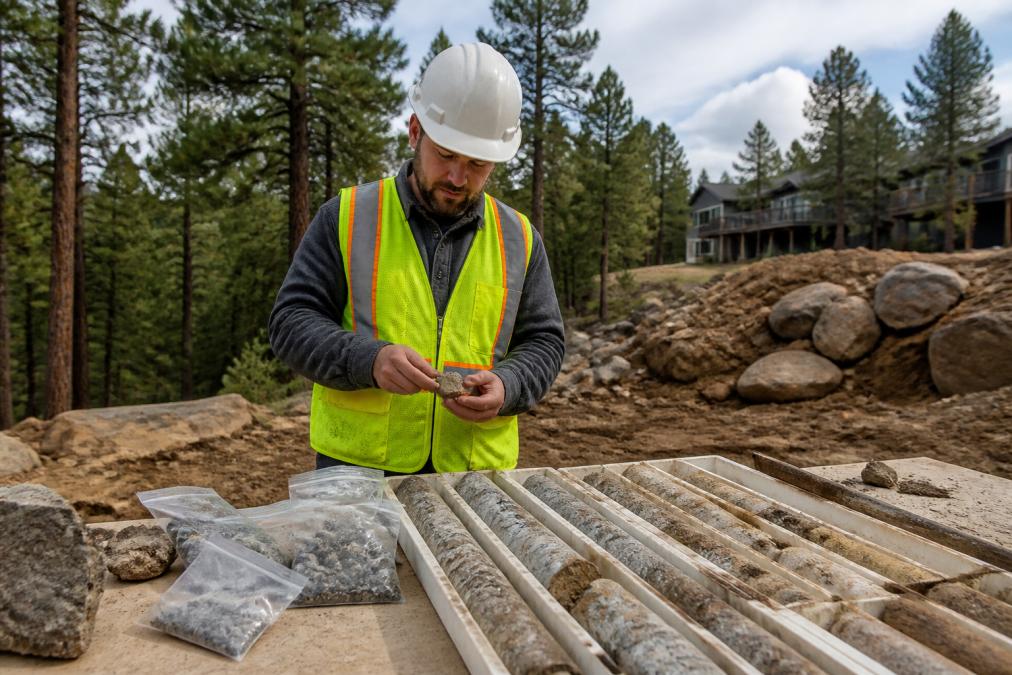
A typical investigation includes:
- Test pits or borings to find bedrock depth
- Soil classification for clay-heavy profiles and decomposed granite
- Load-bearing capacity estimates for foundation design
- Groundwater and moisture retention observations
- Slope stability review on graded lots
What a Soils Report Actually Tells You
A soils report is a document that describes the subsurface conditions on your lot and recommends how to build on them. It tells you where bedrock sits, how much weight the ground can carry, and what drainage steps your foundation needs.
Foundation Types for Rocky Soil: Matching the Right System to Your Site
Foundation types for rocky soil fall into three main families, and the right pick depends on bedrock depth, slope, and how the granite weathers across the lot.
| Foundation Type | Best For | Watch Out For |
|---|---|---|
| Slab-on-grade | Shallow, level bedrock with uniform bearing | Poor drainage, frost movement, point loads over voids |
| Crawl space | Sloped lots, uneven rock, accessible utilities | Moisture under the floor, venting, insulation detailing |
| Pier and beam | Deep bedrock, steep sites, tree-root zones | Higher excavation cost, pier spacing, lateral bracing |
| Post-tension slab | Expansive clay pockets mixed with decomposed granite | Requires specialty contractor, tendon layout review |
How Load Actually Transfers Into Granite
Load-bearing capacity is the amount of weight the ground can support per square foot. When granite sits shallow, capacity is usually high, but the surface is uneven and the rock is not monolithic. The design has to answer three questions:
- Where does the rock start? Test pits and borings establish bedrock depth. A footing that assumes 4 feet of soil and hits rock at 18 inches is a change order.
- How sound is the rock? Weathered granite and decomposed granite (DG) behave very differently from intact bedrock. A geotechnical engineer classifies the material, not just its depth.
- How does the load get there? Pinned piers drill into sound rock and transfer load through the pin. Stepped footings follow the rock profile in increments. Grade beams span soft pockets and carry load to competent bearing points on either side.
The Transition Zone Is Where Problems Show Up First
What most guides miss is the transition zone, the edge where bedrock meets softer soil or clay. Differential movement between the two materials is what cracks drywall, binds doors, and opens foundation cracks. A good design ties those zones together with reinforced grade beams or a continuous footing rather than treating rock and soil as separate systems.
Ask your engineer to mark the transition zones on the site plan. Crews can then prep those areas first, which cuts rework during backfill and compaction.
Small-Scale and DIY Foundations on Granite
Most foundation content is written for custom homes. Homeowners building a shed, detached garage, or deck on granite face the same rock but a smaller budget. The principles scale down:
- Deck piers can be set on concrete footings bearing on sound rock, or pinned with rebar dowels into shallow granite. A 12-inch-diameter footing on competent rock often carries a residential deck post without a full engineered design.
- Shed slabs on level DG can use a thickened-edge slab with a compacted base. On sloped rock, a pier-and-beam frame with adjustable brackets is usually cheaper than cutting a level pad.
- Helical piers are an option where rock is too deep to reach economically but soil is unstable. They screw into bearing strata and can be installed with smaller equipment than a drilled pier rig.
Matching the System to Your Site
A flat lot with deep DG and no visible rock may take a conventional slab with a reinforced perimeter. A lot with outcroppings 20 feet from a seasonal drain field needs pinned piers, stepped footings, and a drainage plan that keeps water off the transition zone. The foundation type is not a style choice, it is a response to what the soils report says is under your footprint.
Excavation Costs in Granite Terrain: What Drives the Price
Excavation costs in granite terrain depend on how hard the rock is, how deep you have to go, and how you break it. There is no flat per-yard number, and any builder who quotes one before seeing your lot is guessing.
The main cost drivers:
- Bedrock depth and hardness
- Access for excavation equipment
- Volume of rock that needs breaking versus digging
- Hauling and disposal of spoils
- Backfill and compaction requirements
Manual Digging vs. Heavy Machinery: A Cost-Benefit Breakdown
Most guides skip this comparison. Here is how the methods stack up on a granite-heavy residential lot.
Manual digging (hand tools, mini-excavator, jackhammer)
- Best for: small footings, pier holes, utility trenches, tight access where a full-size machine cannot reach
- Speed: slow, a two-person crew may move a few cubic yards of decomposed granite per day, and far less in weathered rock
- Cost profile: low equipment rental, high labor hours
- Risk: worker fatigue, inconsistent excavation depth, higher chance of undercutting a footing
Heavy machinery (excavator, rock saw, hydraulic breaker)
- Best for: full basement digs, large footprints, driveways, septic fields
- Speed: a mid-size excavator with a hydraulic breaker can remove rock that would take a hand crew weeks
- Cost profile: high mobilization and rental, lower labor per yard
- Risk: access limits, damage to surrounding trees, vibration complaints from neighbors
Blasting
- Best for: large volumes of intact bedrock where breaking is impractical
- Speed: fastest for hard rock
- Cost profile: highest upfront, permits, licensed blaster, vibration monitoring, insurance
- Risk: oversight, neighbor notification, potential delays if a vibration complaint is filed
What Actually Moves the Number
Three variables swing excavation bids more than anything else:
- Rock hardness. Decomposed granite digs like dense soil. Weathered granite breaks with a breaker. Intact bedrock may need drilling and splitting or blasting. The same lot can have all three.
- Access. A lot with a narrow driveway and mature pines may require a smaller machine, which means more days on site. A clear lot with road frontage lets a larger excavator work efficiently.
- Spoils disposal. Rock and soil removed from the site have to go somewhere. Hauling costs scale with distance and volume. On-site reuse for grading or backfill cuts that cost but requires the material to meet compaction specs.
How to Compare Bids Without Getting Burned
Ask each contractor to specify:
- The method they assume (dig, break, blast, or hybrid)
- The equipment they plan to mobilize
- How they handle rock encountered below the assumed depth
- Whether spoils stay on site or get hauled
- Unit pricing for additional rock removal
The cheapest excavation bid is often the one that missed rock. Compare bids on method, not just total. A low number that assumes soft digging becomes a change order the week crews hit granite.
Ask for a unit price on rock removal before you sign. A bid that assumes soft digging and has no rock line item is not a low bid, it is an incomplete one.
Erosion Control During and After Excavation
Excavation exposes soil and DG to stormwater. On sloped lots, that material moves. Plan for silt fence, straw wattles, and temporary stabilization on any exposed grade before a storm event. Granite-derived soils are prone to shifting when saturated, so a slope that looks stable in dry conditions can fail after a heavy rain. Permanent erosion control, vegetation, riprap, or stabilized DG, should go in as soon as final grade is reached.
Site Preparation and Drainage on Granite Outcroppings
Site preparation on granite outcroppings is about moving water away from the house before it finds a path in. Granite sheds water fast, so the risk isn’t absorption. It’s concentration.
Plan for:
- Grading that slopes away from the foundation on all sides
- Natural drainage swales that follow the existing topography
- French drains or drain field installation where water pools
- Retaining walls on cut slopes to hold grade
- Erosion control before any exposed soil sits through a storm
Placing a drain field in compacted fill is a common mistake. Percolation drops, the field fails inspection, and you’re re-digging a system you already paid for.
Landscaping and Erosion Control with Decomposed Granite
Landscaping with decomposed granite works with the site instead of fighting it. The material compacts into a stable surface, drains well, and blends with the natural surroundings.
Use it for:
- Pathways and driveways
- Borders around native plantings
- Erosion control on gentle slopes
- Aggregate base under patios
Planting in Acidic Granite Soil
Granite soil tends to run acidic, so soil pH matters more here than most homeowners expect. A simple test tells you where you stand before you buy plants.
Plants that handle acidic, rocky ground well:
- Ponderosa pine and other native conifers
- Juniper and native shrubs
- Yarrow and other drought-tolerant perennials
- Native grasses for slope coverage
Conclusion
Granite ground rewards planning and punishes shortcuts. Test the soil, design for the rock you actually have, and handle water before it handles you.
Frequently Asked Questions
What are the main challenges of building on granite soil?
Granite soil creates three primary challenges. First, excavation is slow and expensive because bedrock and granite outcroppings resist standard digging equipment. Second, water does not drain evenly through decomposed granite and clay-heavy profiles, so drainage must be engineered rather than assumed. Third, foundations need design changes because load-bearing capacity varies across a single lot. A soils report and careful site preparation address all three before construction starts.
Does granite soil require special foundation engineering?
Yes. Standard foundation designs assume uniform soil conditions, but granite terrain rarely provides that. An engineered foundation designed around your specific subsurface conditions is essential. This often means pier-and-beam systems, reinforced slabs, or stepped footings that follow the slope. A geotechnical engineer and your builder work together to match the foundation type to what the soils report reveals about your lot.
How do I prepare a building site with high granite content?
Start with a soils report and site survey to map granite outcroppings and subsurface conditions. Then plan for heavier excavation equipment and possibly rock breaking or blasting. Grade the site to direct water away from the foundation, install proper drain field and drainage systems, and compact backfill in layers. Skipping any of these steps leads to foundation movement, moisture problems, and costly repairs later.
Is decomposed granite good for landscaping in Black Forest?
Decomposed granite works well as landscaping gravel and for erosion control on slopes, but it has limits. It compacts into a firm surface that sheds water, which helps with drainage around foundations. For planting, granite soil tends to be acidic, so choose plants that tolerate low pH or amend the soil. Use decomposed granite for paths, borders, and erosion control rather than as a primary growing medium.